SEO and SEA are, without exaggeration, the two most important levers in digital marketing for Swiss companies. Whether you run a shop in Zurich, offer B2B services from Zug or want to grow nationally, visibility in Google search results decides whether potential customers find you or your competitor. This article breaks down how search engine optimisation (SEO) and search engine advertising (SEA) actually work, where they differ, and why combining both is almost always the smarter play.
Why do SEO and SEA at all?
With search engine optimisation (SEO) and search engine advertising (SEA), operators of websites and shops take measures to achieve better rankings in Google search queries. Even though both marketing instruments are fundamentally different, they pursue the same goal. If search queries relevant to one’s own website are entered in Google, Bing or other search engines, one’s own page should appear before the competition in the search results.
Google & Co. decide in which order the listed websites are displayed according to the determined relevance. The first entries are created by advertisements that match the search term. After this, the organic search results are displayed, whereby quality, added value and professionalism of the website are in the foreground. These aspects can be influenced by SEO and SEA. What we see in practice: Swiss SMEs that invest in both channels consistently outperform competitors who rely on just one.
Basic information on search engine optimisation (SEO)
With search engine optimisation, website operators exert a long-term influence on the organic search results of Google and other search engines. SEO has become increasingly complex over the last two decades and leads to penalties if done incorrectly. This is precisely why professional support is advisable. According to current industry data, roughly 68% of all online experiences still begin with a search engine query, meaning organic visibility remains non-negotiable in 2026.
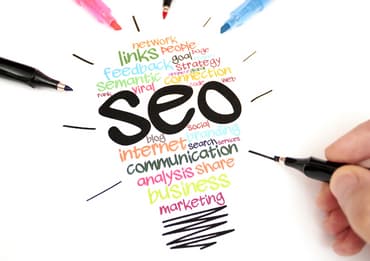
Over the years, the spectrum of factors that go into the evaluation of websites has grown. Original evaluation factors have not lost relevance, but are supplemented by many other aspects. Among the most important of these aspects are:
- Unique content with added value and relevant keywords
- Establishment of a thematically relevant backlinking structure
- Professionally written and error-free source code
- Text-professional web design with responsive programming
- Integration of media elements in high quality
- Link to social media
- and much more.
Within individual aspects, SEO has changed greatly. Today, for example, it tends to lead to devaluation to frequently stuff a term into texts just because it is assumed to be a search term. Google switched to a semantic search years ago, so that it is no longer solely about exact wording. This gives better positioning to websites that, for example, answer questions entered in a factual and detailed way. AI-generated content without editorial review is increasingly flagged too, something we monitor closely for clients across German-speaking Switzerland.
How web design and web programming feed into SEO
Basically, Google and other search engines want to ensure that websites are up to date and maintained by their operators. Old websites fall behind accordingly. An important example is checking whether a website or shop has been programmed responsively. This means that the page is optimally displayed on PCs and laptops as well as on mobile devices.
Websites have long been in danger of dropping out of Google’s search index completely if they do not meet modern, mobile standards. Core Web Vitals scores, page speed and clean technical architecture now carry significant weight in ranking decisions. The quality of texts, information and links is therefore no longer the only decisive factor. A professional web agency can ensure that web development and web design meet the required standards.
Basic information on search engine advertising (SEA)

SEA, which stands for search engine advertising, refers to the targeted placement of advertisements on search engines such as Google. All platforms have their own advertising network for this purpose, the best known being Google Ads. The principle has long since been adopted by social media with Facebook Ads or Instagram Ads, which function similarly to SEA.
After registering for the advertising programme, certain keywords and phrases can be selected for advertisements via bidding. If these are entered as search terms, specially formatted advertisements are displayed in the first entries of the results page. The principle is familiar to every Google user, whereby the top entries are always marked as advertisements.
Search engine advertising is commercial. When working with an online agency, an advertising budget is set that is used for individual search terms in the Google Ads network. As a rule, billing is based on the cost-per-click principle. Only when the user of the search engine sees the advertisement and clicks on it is the previously determined amount debited. In competitive Swiss markets like financial services or real estate in Zurich, CPCs can range from CHF 2 to well over CHF 20 per click, which is why smart campaign structure matters enormously.
Is it enough to only do SEO or SEA?
Both marketing instruments differ in type, measures and effect. Therefore, they do not compete with each other and can be operated in parallel. Above all, the time factor fundamentally distinguishes the two approaches:
- Search engine optimisation is designed for long-term success. If a website is successively optimised according to the criteria that are important for Google, Bing & Co, good rankings can be achieved and consolidated. Although the search algorithm is regularly adjusted, the organic top positions achieved are permanently maintained through constant fine-tuning.
- Search engine advertising is ideal for short-term advertising. It can be used if the website or shop cannot yet be found in top positions due to the lengthy search engine optimisation. Especially for new websites, it is worthwhile to use this tactic to quickly attract attention to the web offer. The same applies to constantly changing content such as top offers and discounts.
Can this marketing be used without professional help?
Theoretically, it is conceivable to use both marketing tools without the experience and professionalism of an agency. In both cases, one would have to live with a major disadvantage.
Search engine optimisation has become so complex that checking various criteria is only possible with special SEO tools. Making adjustments on the off chance quickly leads to a devaluation of the page. Since the requirements change gradually due to updates of the algorithm, the website operator must constantly stay on the ball. This is hardly possible professionally alongside the actual core business.
Search engine advertising is easier to do yourself. The user registers in a network such as Google Ads and uses their budget to place ads matching search terms. Unfortunately, this is often done without a well thought-out strategy. If the ads do not work, a lot of money is burned and the ROI decreases significantly. Our experience shows that self-managed Google Ads accounts in Switzerland waste on average 30 to 40% of budget on irrelevant clicks due to missing negative keyword lists alone.
ONELINE therefore recommends relying on a professional agency, at least in the initial phase. This makes it easier to find out how both marketing tools work and how to use them efficiently. For companies looking to go further, our AI automation services can complement SEO and SEA with smarter lead handling and content workflows.
This article was written by the ONELINE team. We have been supporting Swiss companies in digital transformation for over 10 years, from SEO and SEA to AI automation and lead generation.
Frequently Asked Questions
How long does it take before SEO shows results in Switzerland?
Realistic timeframe: three to six months for measurable movement on competitive keywords, up to twelve months for top positions in contested niches like legal, finance or real estate in Zurich and Zug. Newer domains take longer. SEA fills this gap while SEO builds momentum.
What budget should a Swiss SME plan for Google Ads?
There is no universal answer, but a starting point of CHF 1,000 to 2,000 per month in ad spend is often the minimum to gather meaningful data in most Swiss markets. Highly competitive sectors require more. Management fees for the agency come on top.
Can SEO and SEA be run simultaneously without cannibalising each other?
Yes, and in fact they work better together. SEA data reveals which keywords actually convert, informing SEO priorities. Ranking organically for a keyword where you also run ads increases overall click-through rate and brand credibility on the results page.
Does ONELINE work with companies outside of Zurich and Zug?
Absolutely. While our offices are in Zurich and Zug, we work with clients across German-speaking Switzerland and beyond. SEO and SEA campaigns are managed remotely without any loss of quality or communication.
{“@context”: “https://schema.org”, “@type”: “Article”, “headline”: “SEO & SEA – two valuable marketing tools”, “description”: “SEO & SEA for Swiss companies: how both tools work together, what they cost and when to use which. Practical guide by ONELINE Zurich.”, “author”: {“@type”: “Organization”, “name”: “ONELINE”, “url”: “https://oneline.ch”}, “publisher”: {“@type”: “Organization”, “name”: “ONELINE”, “logo”: {“@type”: “ImageObject”, “url”: “https://oneline.ch/logo.png”}}, “datePublished”: “2022-09-09”, “dateModified”: “2026-07-19”, “mainEntityOfPage”: {“@type”: “WebPage”, “@id”: “https://oneline.ch/en/blog/2455/”}}