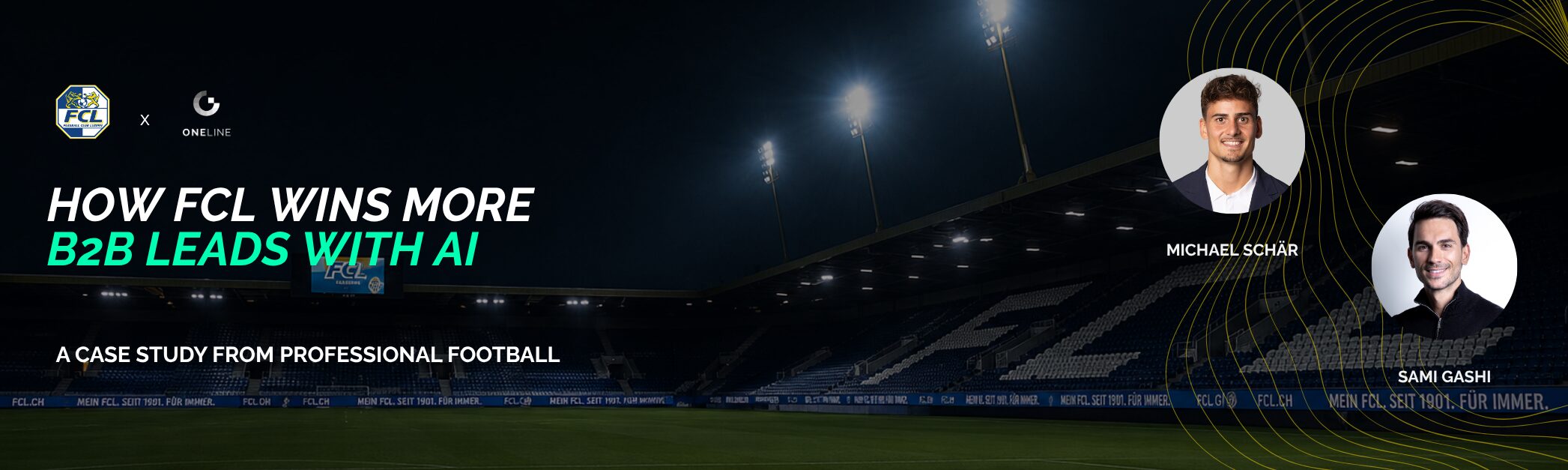
How does B2B lead generation work when classic cold calling barely delivers results anymore? This was the central question of our first ONELINE webinar. Sami Gashi from ONELINE and Michael Schär, Sales Manager at FC Luzern, showed live how modern lead generation with AI looks in practice. We deliberately focused on just one part of the vast topic of AI. In the video you can watch the full recording. We have summarised the key points for you here.
Why classic B2B lead generation reaches its limits
Many companies still run B2B lead generation almost the same way they did ten years ago. That is surprising, because Covid and the rise of AI have changed the market considerably. Four approaches dominate customer acquisition, and each one has a fundamental problem.
Cold calling means a lot of effort for a low hit rate. You have to be in the right place at the right time. Referrals are excellent in quality, but not predictable. Nobody knows how often they will be recommended in the coming months.
Paid advertising on LinkedIn or Meta is expensive and noisy. Organic posts alone are rarely enough. The pattern is the same across all four approaches. Most measures are neither predictable nor scalable. And a lot of effort fizzles out without ever turning into an appointment.
Two challenges that slow down sales
At their core, all these problems come down to two challenges. The first is finding the right target group and the right data. There are thousands of companies in Switzerland. A sales manager has to filter out the few that are truly a good fit.
The second challenge is reaching people at scale. Even after filtering, thousands of relevant contacts often remain. Approaching each one personally takes an enormous amount of time. And nobody wants to feel like they are receiving yet another marketing campaign.
The solution: four pillars and a system called Auto Monkey
To solve exactly these two problems, ONELINE developed Auto Monkey. The system rests on four pillars: data, personalisation, automation and the human. The AI takes over the entire digital workload of a sales manager.
It researches suitable companies and finds the right contacts. It creates a personal message that comes across as likeable. It sends the messages and follows up as many as three times. The system even recognises when a contact is away, for example on holiday, and reaches out again later.
The decisive point: the human stays at the centre. Sami Gashi captured it with an image. The sales manager only has to convert the free kicks. The AI searches for the needle in the haystack. That leaves more time for what matters: advising and closing.
FC Luzern as a live case
FC Luzern is far more than a first team. Including its entire youth academy, the club employs around 240 people. About 26 of them work at the head office, and only a few in sales and marketing. That is why Michael Schär described the starting point very openly.
Around eighteen hours a week went into research, selection and follow-ups alone. He searched trade directories, magazines and old contacts for suitable companies. He researched every company and every contact by hand. It is a workload that many sales teams know all too well.
The process with Auto Monkey ran in four steps. First, the target group was defined. For FCL it was clear quickly: relevant companies in Switzerland, with a focus on the region. Then the team built a database and deliberately excluded ongoing negotiations.
In the third step, personal email variants were created. The fourth step, sending and following up, runs automatically. A broad approach was important to FCL. Instead of immediately offering a single product such as LED boards, the outreach stayed open. This let the prospect decide for themselves what suited them.
Another success factor was continuous optimisation. When an email variant performed worse, it was adjusted. This way the response rate improved step by step. The result is convincing: the collaboration has generated over 300 qualified leads. You can find the full FC Luzern case here.
What surprised Michael Schär most was how quickly and how strongly his calendar filled up. Many contacts were also warm leads. They signalled interest for a later point in time, perhaps in one or two years. And the conversations kept sparking new ideas for reciprocal deals that nobody had thought of before.
One more effect was particularly interesting. The system finds hidden champions. These are companies you would never have contacted on a gut feeling, because their website or name does not stand out. Yet that is often exactly where untapped potential lies.
The most important learnings from the webinar
The central message was clear. Lead generation has changed, it has not stopped. What worked years ago often no longer works today. Anyone who wants to stay successful has to stay flexible.
One principle ran through the entire webinar: the speed of implementation. It refers to how quickly a company adopts new technologies. Those who start early ride the wave. Just as important is the courage to try something new and then optimise it continuously.
Equally central is the personal touch. B2B remains a people business. The Swiss market is more reserved here than the German one. You build a relationship first, rather than selling straight away. And it is never about a single tool, but about a system tailored to each company.
Frequently asked questions about B2B lead generation with AI
How does ONELINE ensure the quality of the AI emails?
The foundation is the experience from over a hundred campaigns. Every campaign runs through its own dedicated IP address and is properly whitelisted. All texts are defined together with the client in a workshop before a single message goes out. Through a backend, the client keeps full visibility at all times.
Do automated emails not feel impersonal?
This is exactly where the difference lies. ONELINE works with hyper-personalisation, not standard mass emails. The goal is for the message to sound as if a person had spent half an hour engaging with the recipient. In over ninety percent of cases, the contact does not notice that the email was automated.
How does this differ from a tool like Lemlist?
ONELINE sees itself as a go-to agency, not merely a tool. In the end, someone still has to operate a tool. As a B2B lead agency, ONELINE takes over the entire process: from the target group and the outreach to strategic advice. Sales know-how and market knowledge are included.
What does B2B lead generation with Auto Monkey cost?
ONELINE works as a hybrid agency, with one fixed part and one performance-based part. The package size is based on a sales manager workload. The smallest package essentially replaces a sales manager, at considerably lower cost. We clarify the exact investment individually in a conversation.
Request your free target group analysis now
Would you like to know how big your potential is within your target group? We will prepare a non-binding and free analysis for you. This shows you concretely how many suitable companies are a fit for you. Request your demo now and talk to our team.