In Brief
Your customers no longer search only on Google, but also in ChatGPT, Gemini and the like. To show up there, you still need good SEO as a foundation, because GEO does not replace SEO, it builds on it. What is new: content that answers a question immediately, AI crawlers that are not blocked and mentions on other sites. Start with the quick wins from Search Console and test whether ChatGPT names you for real customer questions.
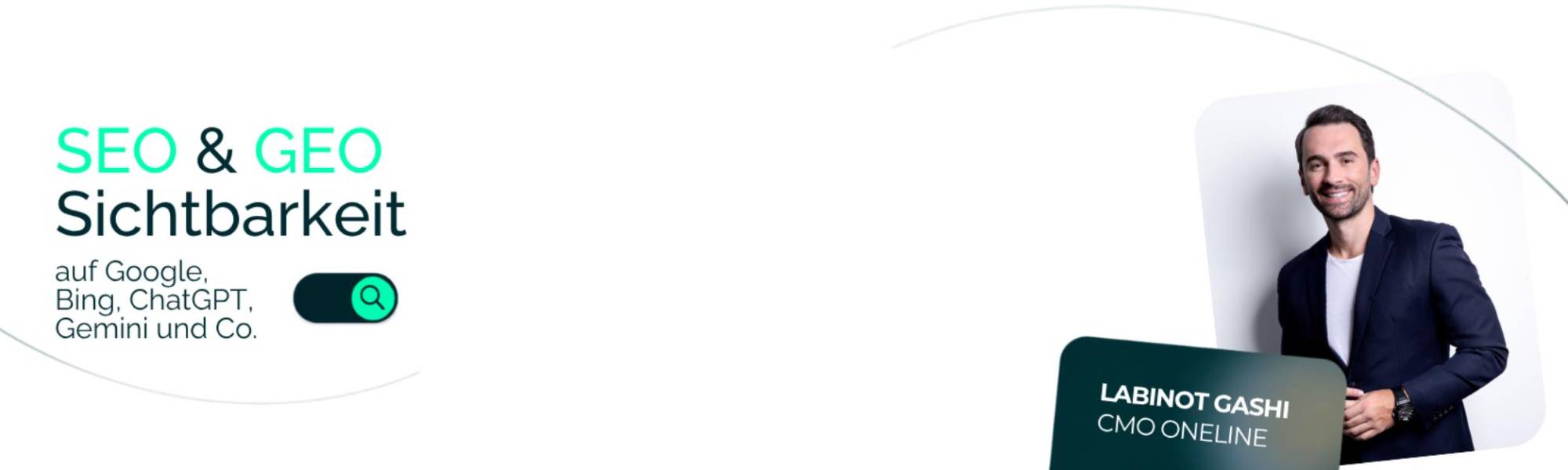
SEO and GEO now determine whether your company shows up when customers look for a solution on Google or in ChatGPT. This article summarizes the ONELINE webinar “SEO & GEO” from October 2, 2026 and shows how search is changing and which measures should take priority now. You can watch the recording right here, and you will find more information on the SEO webinar page.
SEO and GEO at a Glance: Three Disciplines, One Goal
Google assembles the results page anew for every search query. Depending on search intent and location, you see ads, an AI Overview, local results, related questions or classic organic results. At the same time, people search in AI assistants such as ChatGPT, Gemini and Perplexity and on platforms such as YouTube, TikTok or Reddit. So the customer journey no longer starts only on Google.
The webinar distinguishes three disciplines:
- SEO (Search Engine Optimization): being found. The goal is a good ranking, with a focus on keywords, technology and backlinks.
- AEO (Answer Engine Optimization): being the answer. What counts are concise, structured answers for snippets and voice search.
- GEO (Generative Engine Optimization): being named as a source. What counts here are authority, context and machine readability, measured by citations and mentions.
GEO does not replace SEO. AI systems draw on pages that are crawled, understood and classified as trustworthy. Good SEO work remains the foundation, meaning clean on-page and off-page optimization. GEO is the next layer on top.
Why Rankings Alone Are No Longer Enough
More and More Searches End Without a Click
In the first four months of 2026, according to SparkToro, 68.01 percent of Google searches in the US ended without a click. In 2024, the figure was 60.45 percent. The 2026 figures come from Similarweb’s clickstream panel, the 2024 figures from the data provider Datos, and both refer to the US. This figure is not available for Switzerland.
Position 1 Delivers Less Than It Used To
According to Backlinko, the first result receives an average of 27.6 percent of clicks, and the top 3 together more than half. With an AI Overview, the picture shifts. Ahrefs analyzed 300,000 keywords and found that the click-through rate for position 1 on keywords with an AI Overview fell by 58 percent between December 2023 and December 2025.
Those Who Are Cited Get More Clicks
Seer Interactive analyzed informational search queries from 42 client sites. In the third quarter of 2025, the organic click-through rate was 0.70 percent with a citation in the AI Overview and 0.52 percent without one. That is 35 percent more clicks. Seer itself points out that the cause remains open: strong brands may simply be cited more often and clicked more often.
How an AI Answer Is Created
An AI answer is created in five steps:
- A person asks a question in natural language.
- The AI breaks it down into several sub-questions and searches for sources for them.
- Relevant passages are selected.
- The language model summarizes the best passages.
- The answer appears with a few source links.
What this means for your content:
- Every section has to make sense on its own, because AI cites passages, not entire pages.
- Topics need to be covered broadly and in depth, because many sub-questions are searched for a single question.
- Content that is technically unreachable, for example behind a login, will not be found.
Technology: The Foundation for Google and AI
Allowing or Blocking Crawlers
First, check your robots.txt, XML sitemap, noindex tags and canonicals. Also fix 404 errors and redirect chains. After that, it is worth looking at the AI crawlers. According to OpenAI’s documentation, the OAI-SearchBot is responsible for search in ChatGPT, while GPTBot is used for training. If you block the OAI-SearchBot, you will not appear in ChatGPT’s search answers, at most as a navigational link.
At Google, according to Google, the Google-Extended token controls whether your content is used to train future Gemini models and for grounding in Gemini Apps. It has no effect on inclusion in Google Search. So blocking it does not affect classic search.
Structured Data and Readable HTML
With schema markup, machines recognize who you are and what you offer. A good baseline is:
- Organization or LocalBusiness: name, address, phone, logo and profiles
- Person: authors with expertise
- Article: author, date and update
- Product, Offer and Review: for products and ratings
Important content should also be directly in the HTML and not loaded later via JavaScript.
Content: Answer First
A section becomes quotable when it answers the question immediately. Instead of starting with a long introduction, the answer appears right below the heading “How much does a heat pump cost?”, followed by details, a table and a sample calculation. The webinar names four rules:
- The question is the H2, phrased the way customers ask it.
- The answer is in the first 40 to 60 words, followed by the details.
- Each section covers one topic and makes sense on its own.
- Author and date are visible, and the content is updated regularly.
Modular building blocks work well for this: FAQ block, how-to steps, definition, dos and don’ts, an info box with a figure and a clear call to action. You can find more about the role of content in our glossary.
What Stays the Same in SEO Copy and What Changes
What stays the same: the main keyword in the title, H1, URL and first paragraph, exactly one H1 with several H2s and H3s, and images with alt text. Paragraphs of up to 150 words and sentences of up to 20 words work well. These points are new:
- Length depends on what is needed, not on a word count.
- Entities replace keyword density: terms, brands and places count.
- AI helps with research and drafting, but your own experience, data and examples need to be added.
- Facts are backed by sources, and the content is visibly up to date.
Authority: What Others Say About You Counts
Search systems and AI evaluate not only your website, but also what is said about you elsewhere. Three levers matter here:
- Show E-E-A-T: real projects and case studies, author pages with qualifications, legal notice, reviews and certificates.
- A clear entity: name, address and phone number are identical everywhere, the Google Business Profile is maintained, and reviews are central for local SEO.
- Mentions: trade media, associations, comparison sites and platforms such as YouTube, LinkedIn or Reddit. Searches like “best X in Y” often bring up list articles from third parties. If you appear there, you win.
With backlinks, quality still beats quantity. A link from a recognized specialist site carries more weight than many links from random sites. Multilingual websites should fully build out every language and set hreflang correctly, because AI systems answer in the language of the question.
SEO, GEO and Google Ads: Not Either-Or
Google Ads work immediately and can be controlled by region, time and budget, but every click costs money. SEO and GEO work more slowly, but build lasting value. In our experience, the first quick wins show up after 4 to 8 weeks and real impact after 3 to 8 months. That is a rule of thumb, not a guarantee.
Seer also measured that the ad click-through rate for informational queries with an AI Overview fell from 19.70 percent in June 2024 to 6.34 percent in September 2025. The recommendation is therefore: use Google Ads for immediate impact and tests, and put keywords that convert well in Ads on the SEO priority list.
Measuring Success: New Metrics for GEO
Besides rankings and traffic, the webinar highlights these metrics:
- impressions and clicks in Google Search Console, including AI Overviews and AI Mode
- a separate “AI” channel group in Google Analytics 4 for chatgpt.com, perplexity.ai, gemini.google.com and Copilot
- the brand’s visibility in the SISTRIX AI Check
- citations and mentions in AI answers compared with competitors
- a prompt set of 20 to 50 real customer questions that you test every month
In the first months, expect impressions to rise while clicks stay away. That is normal, because AI Overviews can show your page without anyone clicking. Citations also fluctuate from day to day, so one-off tests are misleading. In the end, inquiries and revenue count, not just visitor numbers.
The 90-Day Roadmap
Days 1 to 30: Analysis and Technology
- SEO and GEO audit
- Quick wins from Search Console, for example keywords in positions 4 to 20
- Check AI crawlers and robots.txt
- Set up a schema baseline
Days 31 to 60: Content
- Revise the most important pages according to the “answer first” principle
- Add FAQ and info blocks
- Create briefings for new cluster pages
- Expand internal linking
Days 61 to 90: Authority and Monitoring
- Maintain the business profile and reviews
- Build mentions, PR and directory listings
- Start prompt tracking
- Introduce monthly reporting
Your To-Dos Starting Tomorrow
- Export keywords in positions 4 to 20 from Search Console
- Put the core answer in 50 words or fewer at the top of your five most important pages
- Check robots.txt and your firewall: are AI crawlers allowed?
- Set up Organization or LocalBusiness schema and author pages
- Test ten customer questions in ChatGPT and Gemini: are you mentioned?
- Update your Google Business Profile and actively collect reviews
Watch the Webinar
The interplay of SEO and GEO is not a project with an end date, but an ongoing process. In the webinar, you get the entire approach in 90 minutes.
Want to know where your quick wins are? Get in touch with us for a potential analysis or email us at office@oneline.ch.

Written By
Bettina Abelman
Junior Online Marketing Manager at ONELINE in Zug, focused on digital marketing, SEO, and lead generation. Learn more about Bettina →