Answer First Content determines how companies get found in AI systems. Why structure matters more than keywords, this article explains. Artificial intelligence and generative search systems are increasingly shaping how people find information and make purchasing decisions. AI Overviews appear in more and more search results. ChatGPT, Perplexity and Claude answer an enormous number of questions directly in their chats every day. The classic click on a website is becoming less common as a result. Yet links, source references and concrete offers remain part of many AI responses.
For businesses, this development is no cause for alarm, quite the contrary. AI presents promising opportunities for additional reach. Traditional search is not disappearing but reorganising itself. However, the existing SEO playbook alone is no longer sufficient. Title tags, meta descriptions and keywords remain important. Language models additionally evaluate whether content answers a question more clearly, quickly and completely than other available sources. Answer First Content delivers a key signal for this.
What Is Answer First Content?
Answer First Content means that the actual answer appears directly at the start of a section. Long run-ups, general introductions and vague preambles are dropped. Instead, a heading is followed immediately by a short, self-contained core statement. Supporting evidence, examples and deeper details come afterwards.
This principle makes it easier for both humans and AI systems to access relevant information quickly. Readers immediately recognise whether a section answers their question. A language model can simultaneously grasp the central statement more easily, classify it and use it in a response.
How Does AI-Citable Content Work in LLMs?
An AI system does not read a website the way a human reads it, top to bottom. When faced with a specific query, it scans for text passages that are semantically relevant to the search. Particularly valuable are sections whose statements remain understandable without additional context. This is precisely where Answer First Content increases the chance of being cited.
An example illustrates the selection process. For the query “How long should a meta description be?”, the language model searches available websites and documents for matching text passages. One begins with an extensive overview of the history of search engines; the actual length recommendation only appears much later. Another source states the key figure immediately and then explains why variations may occur depending on the search result.
For an LLM, the second passage is easier to process. Question, answer and reasoning sit close together and form an understandable unit even without the rest of the article.
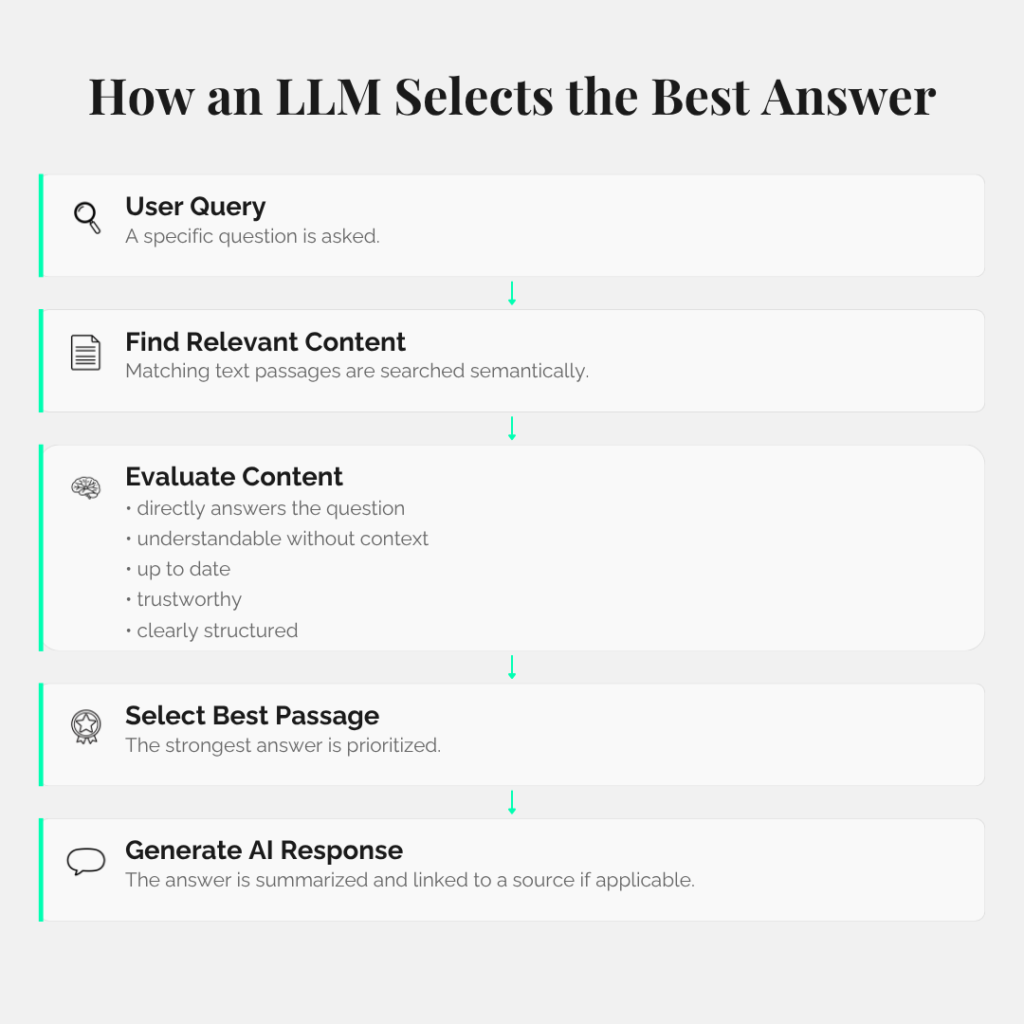
The selection process simplified into five steps:
- The search query is broken down into its meaning and intent.
- Relevant text passages are identified based on terms, context and topic relevance.
- The system checks whether a passage answers the question fully, clearly and directly.
- Sources, recency, structure and internal consistency influence the evaluation.
- The most suitable statements are summarised, quoted and/or linked.
AI-citable content is therefore not created through individual keywords alone. What matters is whether a passage is self-contained, clearly written and professionally sound. An LLM-optimised text helps the system identify the relevant statement without detours.
Writing Content for AI: What Matters
Anyone writing content for AI first needs a clear answer logic. Answer First is considered the core of Generative Engine Optimization, or GEO. The method improves citability because it makes core statements visible and easy to extract. Sources, sentence structure, markup and clear presentation formats play a supporting role.
Implementing Answer First with an Answer Capsule
The so-called Answer Capsule is the first block of text after a section heading. It answers the relevant question completely and without preamble, in 30 to 60 words. Qualifiers such as “possibly”, “under certain circumstances” or “it could be” only belong here if they are technically indispensable.
Each section follows a clear three-step method:
- Direct answer: The core statement comes first. It remains understandable even if only this short section is read. Exceptions and special cases follow later.
- Evidence or context: The second step gives the answer substance. A source, a concrete example or a brief explanation shows why the statement holds.
- Depth and variations: Only then come details, edge cases and industry-specific differences. Readers who want to go deeper find the necessary information here.
This sequence produces an LLM-optimised text that stays easy to scan while still offering professional depth. Answer First Content does not necessarily shorten content. It simply reorders it.
Making Sources and Dates Visible
Current and verifiable information increases credibility. Sources should therefore be clearly named and time-sensitive information should include a date. A figure without an origin is weaker than a statement whose basis can be traced.
For prices, studies, guidelines or technical standards in particular, a publication or update date should signal how fresh the information is. AI-citable content gains in context and reliability as a result.
Making Every Sentence Self-Contained
Pronouns and unclear back-references make text harder to process. A sentence such as “This improves it significantly” remains incomprehensible without the preceding paragraph. A concrete formulation works better: “A clear answer structure improves the citability of a text.”
Not every sentence needs to read like an isolated definition. Yet central statements should name the topic, the action and the result clearly. Anyone writing content for AI reduces ambiguity this way and makes the text easier to scan at the same time.
Adding Schema Markup
Structured data marks certain content for machines. Schema Markup can indicate, for example, that a section is an FAQ, a how-to guide, a product or an article. This technical markup does not replace quality content but supports its unambiguous classification.
An LLM-optimised text therefore remains primarily well-written and clear. Markup complements content quality but cannot compensate for missing clarity.
Using Lists and Tables Effectively
Lists work best for step-by-step instructions, key criteria, pros and cons or brief comparisons. Tables allow multiple key features to be compared at a glance. Both formats make information faster to scan and show relationships clearly.
For this to produce AI-citable content, every element needs a clear label. Abbreviations, isolated bullet points and overloaded table columns hinder interpretation. A brief introduction and precise sentences or bullet points provide the necessary orientation.
Using Terms Consistently and in Context
Synonyms improve readability but must not dilute the meaning of the information. Technical terms should retain the same function throughout the article. If a text switches without explanation between “AI answer”, “search summary” and “citation”, it can become unclear whether the same thing is actually meant.
Answer First Content benefits from both linguistic variety and terminological precision. Central statements should always remain exact. Examples lighten the presentation and the structure should always lead to the answer without detours.
Frequently Asked Questions About Answer First Content
What Is the Difference Between SEO and GEO?
Classic SEO optimises content for search engine rankings through keywords, backlinks and technical factors. GEO (Generative Engine Optimization) goes a step further: it structures content so that AI systems like ChatGPT or Google AI Overviews cite it directly as a source. Both disciplines complement each other. GEO does not replace SEO but builds on it.
How Long Should an Answer Capsule Be?
An Answer Capsule is 30 to 60 words long. It answers the section’s question completely and without preamble. Qualifiers only belong here if they are technically indispensable. Evidence, context and deeper detail follow afterwards.
Does Answer First Content Also Help With Classic Search Results?
Yes. Clear structure, self-contained sections and precise phrasing also improve classic SEO signals such as time on page, click-through rate and readability. Answer First Content therefore works in two directions: for human readers and for AI systems alike.
An LLM-optimised text creates a strong foundation for visibility in generative systems. Would you like to make your content clearer, more citable and future-proof? Get in touch and discuss the next steps.