Google Ads or SEO? For many Swiss SMEs, especially in Zurich and Zug, this feels like an either/or decision. It isn’t. The real question is not which channel works better, but how both work together to drive sustainable growth. In 2026, the combination of Google Ads and SEO remains one of the most effective approaches in digital marketing, and our experience with Swiss clients confirms this every week.
What advantages does Google Ads offer?
Google Ads impresses with its numerous advantages. Nevertheless, there are also limitations.
One important detail in advance: advertisers only pay for the advertisement when users click on the ad.
The other advantages are:
- Ads predominantly addresses potential customers
- Sales-boosting hot leads instead of loss-making cold calls
- Maintain cost control
- Flexibility, measurability and optimisation
- Branding: using Google Ads to increase brand awareness
1. Targeted customer approach and payment per click
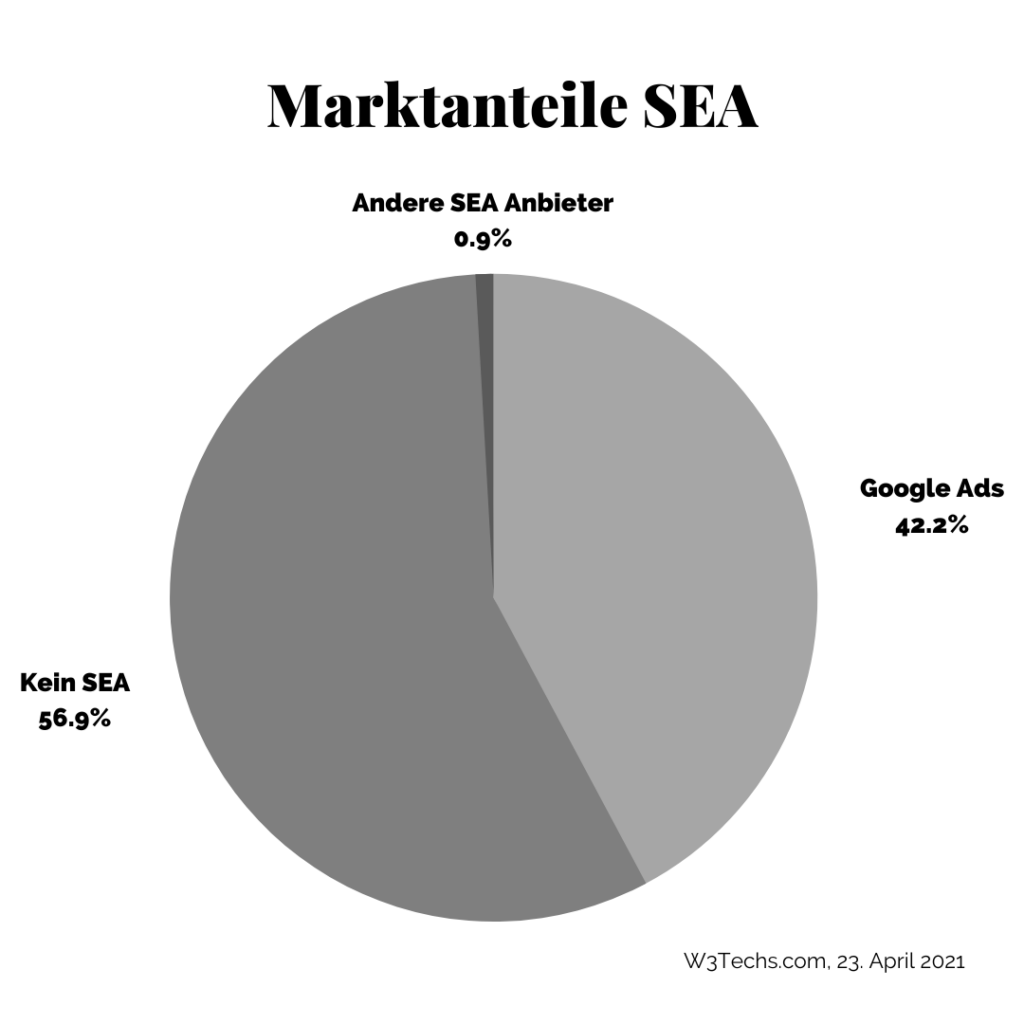
Appropriately selected keywords act as an instrument to address the “right” customers who are actually interested in the product or service.
From the outset, website operators exclude visitors who are not interested in the product, with the appropriate keywords.
As an online marketing tool, SEA enjoys a high level of popularity among website operators. What we see in practice: Swiss companies running Google Ads campaigns consistently outperform those relying on a single channel alone.
With Google Ads, advertisers only pay as much as they have bid.
2. Customers search for the product, cold calling unnecessary
Thanks to Google Ads, cold calling is a thing of the past. Mainly because users explicitly search for a product or service that a company offers. Google Ads attracts the attention of potential customers.
However, the competition thinks the same way. That’s why the perfect keyword selection is a little complicated.
3. Keeping an overview of costs
Advertisers set their daily budget, which gives them full cost control. Companies decide whether they want to spend CHF 15, 30 or 50 per day on their ads. As soon as the budget is used up, Google stops the ad.
4. The underestimated role of measurability and optimisation
The Google Account provides users with all the data relevant to their campaign. Users receive accurate reports according to relevance, time and cost. This allows them to control and optimise their campaigns, ads and keywords. The reports also show how users are using the website.
5. Increase brand awareness
Why is it possible to increase brand awareness with Google Ads? Because the ads target interested customers internationally, at the right time and in the right place on numerous websites.
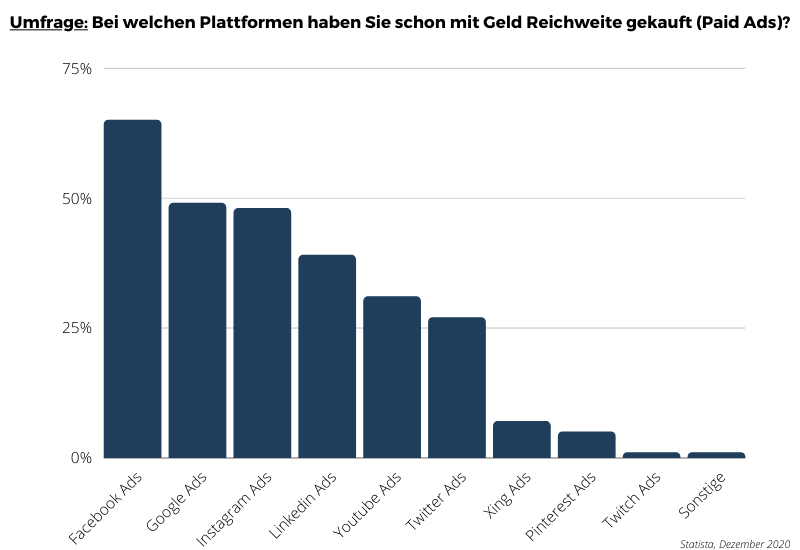
In addition to other paid channels, companies are increasingly counting on Google Ads to buy reach and stay visible in competitive Swiss markets.
Limits and disadvantages of Ads
The high cost factor of Ads tops the list of disadvantages.
- Depending on the budget chosen, the minimum amount is between CHF 10 and 20 per day. That’s between CHF 300 and 600 per month.
- As soon as the advertisements stop running, the number of website visitors and consequently customers decreases.
- Users click on ads less often. Why? They find advertising intrusive and annoying. That’s why they prefer organic search hits.
Conclusion on Google Ads
Sales prove facts. The revenue figures that Swiss companies achieve with Google Ads serve as proof of this online marketing tool’s effectiveness. This method is best suited for the acquisition of new customers.
However, in order to answer to what extent the use of this measure is worthwhile, the benefits of SEO should be considered in depth.
The underestimated effect of SEO
Companies should by no means neglect the optimisation of their website in the meantime.
The following graph illustrates that the click rate on natural search results is significantly higher than on a Google Ads ad, thanks to appropriate search engine optimisation. With a low search volume, the following click distribution results.
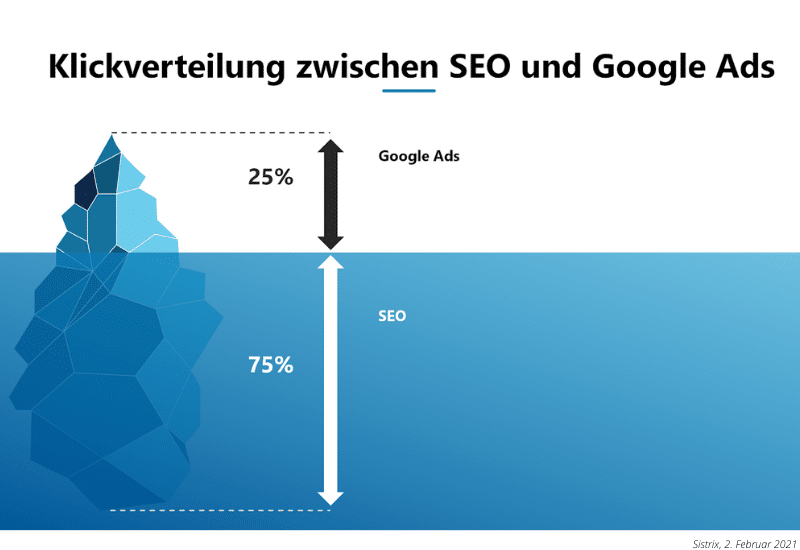
Why does Google Ads nevertheless enjoy great popularity? Quite simple: immediately visible. The ad actually appears in the search results within 24 hours. And SEO cannot compete with this plus point.
SEO requires time. The process can be compared to the maturation of a good wine: wines mature in oak barrels and taste better the older they are. The same applies to SEO. Search engine optimisation takes time to achieve the desired effect. Fortunately, it is by no means a matter of years like with wine, but only of months.
ONELINE emphasises that the high click-through rate within natural search results speaks for an SEO investment. Our experience with clients across Zurich and Zug shows consistently: companies that maintain strong organic rankings spend less per acquired customer over time. But the click-through rate is not the only argument that justifies the use of SEO.
SEO increases traffic sustainably and over several years
Regardless of whether a company does SEO itself or hires an SEO agency, it benefits from the following advantages:
- Sustainable
- Higher visibility with search engines
- Greater sales opportunities
- Best possible target group approach
- High reach
What are the limits of SEO?
It depends on what goal a company is pursuing. That’s why the question of whether it’s worth investing in Google Ads when doing SEO cannot be answered with a simple yes or no. After all, search engine optimisation takes time. Weeks, even months, can pass until the website appears high up on Google.
Companies that are under strong financial pressure cannot rely exclusively on search engine optimisation as a marketing tool. If they want to gain visitors via Google within a short period of time, they need Google Ads.
Comparison between SEO and Google Ads
Both methods direct visitors to the company website. However, there are differences in the approach.
Google Ads and SEO work with well-chosen keywords. Elaborate, time-consuming and cost-intensive. This is true for both measures. In the long run, Ads is more expensive.
With Ads, customers are targeted, whereas with SEO, companies are less able to determine who visits their website. Therefore, investing in the former method pays off, despite higher investment costs.
Thanks to Google Ads campaigns, companies benefit from a high number of visitors within a short period of time if they have optimised the ad and invested a sufficient budget.
In SEO, on the other hand, there is a troublemaker that causes a drop in traffic. Its name is: Google Update. In 2026, Google’s algorithm updates have become more frequent and more impactful than ever. Companies must therefore always be up to date in order to adapt.
Google Ads and SEO are a good combination
According to the ONELINE Marketing Agency, Google Ads and SEO complement each other.
The measures that are necessary depend on the company and the website. A combination of the two methods for search engine marketing is a good solution.
Companies that want to place an ad within a few hours are on the right side with Google Ads. This marketing tool is worthwhile for the acquisition of new customers.
Sustainability plays an indispensable role not only in environmental economics, but also in online marketing. SEO serves as a sustainable online marketing tool to attract visitors via Google over the long term.
It is worth investing in Google Ads even if a company does good SEO, because individually, the measures act as useful online marketing tools, but in combination they are again invincible.
Companies that use SEO and SEA compete better in the marketplace. After all, ambitious entrepreneurs set up a company to solve an existing problem on the one hand and to maximise their turnover on the other.
Google Ads and SEO act as useful tools to fulfil the principle of profit maximisation. Together, they are revenue-generating. If you are unsure where to start, our lead generation specialists can help map out the right mix for your business.
Agency note: AdWords is still a very popular term among users, even though it has since been renamed Google Ads. That is why we have preferred to use Google Ads in this article.
This article was written by the ONELINE team. We have been supporting Swiss companies in digital transformation for over 10 years, from SEO and SEA to AI automation and lead generation.
Frequently Asked Questions
Can Google Ads and SEO be used at the same time?
Absolutely. In fact, combining both is often the smartest approach. Google Ads delivers immediate visibility while SEO builds long-term organic authority. Many Swiss companies run both in parallel to cover all stages of the customer journey.
How much should a Swiss SME budget for Google Ads?
A realistic starting point is CHF 500 to 1,500 per month, depending on industry and competition. In highly competitive sectors like finance or real estate in Zurich, budgets tend to be higher. The key is matching your budget to clear conversion goals, not just clicks.
How long does SEO take to show results in Switzerland?
Typically three to six months for noticeable improvements, sometimes longer in competitive niches. Our experience shows that Swiss companies with well-structured websites and consistent content efforts often see meaningful ranking gains within four months.
Is it better to invest in SEO or Google Ads first?
If you need results quickly, Google Ads is the faster route. If you are building for the long term, SEO is the stronger investment. For most Swiss SMEs, starting with Google Ads while building SEO in parallel delivers the best of both worlds.
{“@context”: “https://schema.org”, “@type”: “Article”, “headline”: “Is it worth investing in Google Ads if you do SEO?”, “description”: “Google Ads and SEO: Is combining both strategies worth it? ONELINE explains the differences, benefits, and why Swiss companies use both.”, “author”: {“@type”: “Organization”, “name”: “ONELINE”, “url”: “https://oneline.ch”}, “publisher”: {“@type”: “Organization”, “name”: “ONELINE”, “logo”: {“@type”: “ImageObject”, “url”: “https://oneline.ch/logo.png”}}, “datePublished”: “2021-04-23”, “dateModified”: “2026-07-04”, “mainEntityOfPage”: {“@type”: “WebPage”, “@id”: “https://oneline.ch/en/blog/1237/”}}