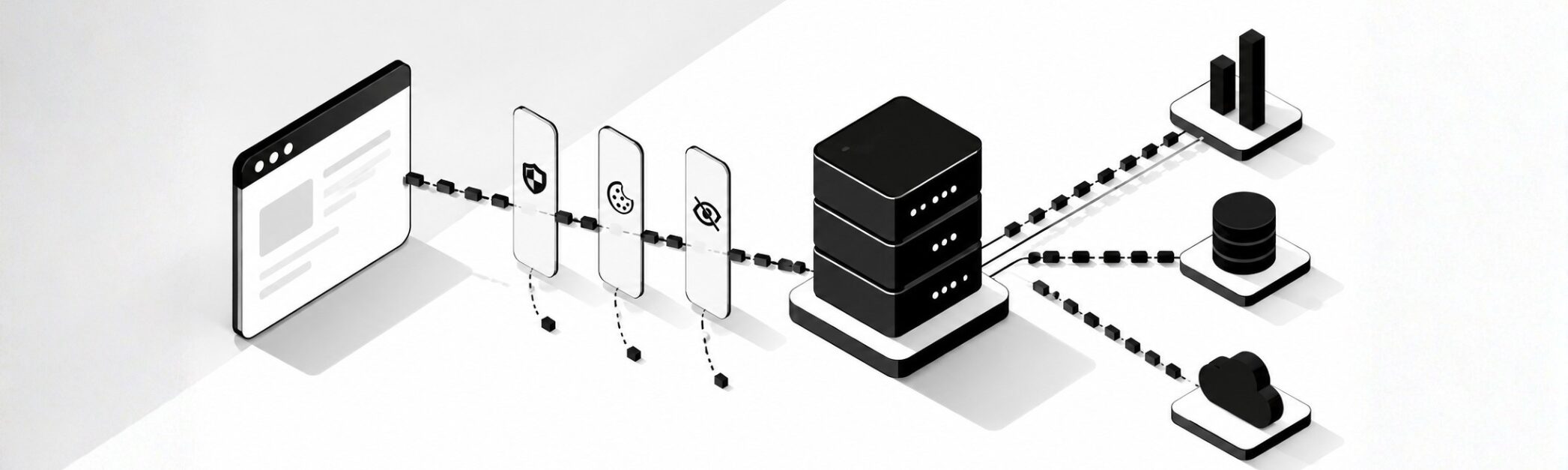
Server side tracking closes a gap that many companies underestimate. In many analytics setups, a significant share of actual conversions stays invisible. Depending on the technical setup, the gap between real closings and recorded events can reach up to 40 percent. Ad blockers, browser protections, missing consent and misfiring tags interrupt data collection at several points.
The spread of ad blockers in Switzerland is worth a closer look. According to GWI data on ad blocker usage, 30.9 percent of Swiss internet users aged 16 to 64 use such a tool at least occasionally. If every tracking request from these people were blocked out of 1,000 real conversions, up to 309 closings would theoretically be missing from analytics. In practice, the number is lower, since not every ad blocker blocks every measurement service. Still, the example shows how quickly a relevant data gap can appear. Further barriers add to this effect.
Server side tracking moves key parts of data collection from the browser to a controlled server infrastructure. Measurement signals can then be processed more reliably and forwarded to analytics or advertising platforms. This article shows where data gets lost. It explains how server-side collection works technically and which steps lead to more reliable conversion measurement.
Why should companies rely on server side tracking today?
With classic client-side tracking, the browser does almost all the work. JavaScript loads the Google Tag Manager and fires the matching tags. The browser sends events such as page views, purchases or leads directly to Google Analytics, Google Ads, Meta and other systems. These platforms handle analysis, performance measurement and campaign management.
This model has always depended on the technical environment inside the browser. Today, advanced protection mechanisms interrupt the data flow far more often.
iOS and App Tracking Transparency
Since iOS 14.5, apps must actively ask for permission before tracking users across other apps and websites. An analysis by Adjust puts the global ATT opt-in rate at 35 percent in the second quarter of 2025. That leaves 65 percent of prompts without consent. For app campaigns, this removes signals needed to attribute installs, purchases and other actions.
Server side tracking does not override this decision. It can, however, process permitted events more consistently and make existing first-party data more useful for measurement.
Safari and Intelligent Tracking Prevention
Safari blocks third-party cookies by default. Apple’s documentation on Intelligent Tracking Prevention confirms full blocking since Safari 13.1. The browser also limits certain storage mechanisms and makes recognition harder over longer periods.
This restriction is particularly relevant for the Swiss market. According to StatCounter, Safari accounted for 26.09 percent of browser traffic across all devices in Switzerland in June 2026. On mobile, the browser reached a share of 42.84 percent. This means Apple’s tracking protection affects a significant part of Swiss web traffic.
Ad blockers interrupt measurement requests
Ad blockers do not just filter visible ads. Many extensions also block known tracking scripts and requests to domains such as google-analytics.com or facebook.com. If a tag does not load, no measurable event is created. Tech-savvy audiences and privacy-conscious visitors can therefore be missing disproportionately from the data.
The Swiss ad blocker rate of 30.9 percent cannot be translated directly into conversion loss. Not every tool blocks every analytics tag. Still, it shows how large the exposed share of traffic can be.
Consent reduces the observable data volume
A correctly configured consent banner only starts non-essential marketing and analytics tags after valid consent. A rejection therefore creates a deliberate measurement gap. Consent Mode passes the consent status to the Google tags. Without consent, it only delivers limited signals for modeled reporting. A fully observed customer journey does not replace this.
GTM server-side refers to the server-side variant of the Google Tag Manager. A server container receives permitted data, checks it and forwards it to analytics or advertising platforms. This method must not bypass consent either. The server container must respect the consent status and block any data processing that is not permitted.
How does server side tracking work?
The key difference lies in the transmission path. In the client-side model, the browser sends tracking data directly to external analytics and advertising platforms such as Google Analytics, Google Ads or Meta. With server side tracking, it sends permitted events to its own endpoint, for example data.example.com. This subdomain leads to a server container, which removes many technical hurdles from conversion measurement.
There, the system checks, cleans and distributes the information. Google Analytics 4 receives data through the Measurement Protocol, for example. Meta processes matching events through the Conversions API. Google Ads can enrich Enhanced Conversions with hashed customer data. Which fields reach which platform can be controlled centrally.
This setup brings several advantages:
- Requests run through a first-party domain instead of directly through known tracking addresses.
- The server can remove unnecessary parameters and standardize data formats.
- Fewer third-party scripts in the browser ease page load time.
- First-party cookies set server-side are more persistent than many JavaScript-based ones.
- First-party data stays more controllable, since external platforms only receive selected information.
This does not make tracking fully invisible to protection mechanisms. Modern blocklists also detect certain first-party constructions. A valid legal basis also remains necessary.
A cookieless conversion refers to a closing whose measurement depends less on third-party cookies. This does not mean that data protection requirements or consent no longer apply.
How to implement server side tracking step by step
A well-targeted implementation of server side tracking starts with comparing measured and actually achieved closings. The technical setup follows afterward.
- Determine the tracking gap: Purchases or leads recorded in GA4 are compared with data from the shop system, CRM or accounting. Time periods, time zones and cancellations must match. If the shop shows 1,000 purchases but GA4 only 650, 35 percent of conversions are missing. This figure forms the basis for later checks.
- Check consent: The consent banner must correctly pass the user’s decision to both browser-side tracking and the server container. Analytics and marketing tags stay disabled until consent is given. Changes or withdrawals must take effect immediately. Only afterward should GTM server-side be set up.
- Set up the server container and domain: A dedicated server container is created in Google Tag Manager. Hosting can run on Google Cloud Run, a specialized provider or your own infrastructure. A subdomain such as data.example.com is connected to the tracking server via DNS. Google recommends a first-party domain, since it supports a first-party context. The web container then sends permitted GA4 events to this endpoint.
- Connect platform APIs: Meta receives data through the Conversions API, Google Ads through Enhanced Conversions or an API connection. GA4 also processes events through the server container. Currency, revenue, transaction ID, timestamp and event name must be consistent and correctly matched across all systems. This alignment improves cookieless conversion measurement and the attribution of closings to campaigns.
- Check measurement quality: After seven to fourteen days, GA4, the shop and the CRM are compared again. It is also worth checking the GTM server-side preview, the Meta Events Manager and the Google Ads diagnostics. Correct required fields, working deduplication, accurate revenue values and compliance with all consent decisions are essential.
Frequently asked questions about server side tracking
Does server side tracking replace Consent Mode?
No. Server side tracking only changes the transmission path of the data. The server container must still respect the consent status and must not bypass consent.
Does server side tracking close the tracking gap completely?
No. Modern blocklists also detect certain first-party constructions. Server side tracking reduces the data gap, but it does not make tracking fully invisible to protection mechanisms.
How can measurement quality be checked after setup?
After seven to fourteen days, GA4, the shop system and the CRM are compared again. It is also worth checking the GTM server-side preview, the Meta Events Manager and the Google Ads diagnostics.
Swiss companies should seriously consider server side tracking today. Implementation requires technical understanding, a good overview and regular checks after launch. For an expert assessment of your existing tracking gap and the right server setup, get in touch now.