Chatbots have moved from a novelty to a standard tool in digital customer service. Swiss companies, from Zurich e-commerce shops to Zug-based B2B providers, are deploying them to handle enquiries at scale, reduce response times, and keep support available around the clock. What was still considered experimental in 2023 is now a baseline expectation in 2026. And with AI models improving rapidly, the gap between a chatbot and a human agent keeps narrowing.
What is a chatbot?
The term chatbot is a compound of the words “chat” and “robot“. It means nothing more than: a robot that chats. These programmes are commissioned by companies. They are specifically “trained” for their respective field of application. This is possible because the heart of a chatbot is usually an AI, a system that is capable of learning.
This AI must be fed with specific information and connected to relevant databases via web development. The relevant databases for chatbots include, for example, customer-related information as well as order data, information on warehouse availability and product data sheets.
The different types of chatbots
How helpful a chatbot is in customer service as part of digital marketing is determined by its “intelligence“. Two basic types of chatbots can be distinguished: rule-based systems and intelligent chatbots. Rule-based systems offer users a selection of topics.
Intelligent systems, on the other hand, can react to free input from the user. Rule-based systems are not particularly complex and do not require AI. Systems with free input are usually very complex and have AI and natural language processing.
You can learn more about this in this video.
Both types of chatbots are available around the clock. This means that webshops can offer their customers a contact person at any time, even overnight or at the weekend. And they can use the bots to guide customers through the ordering process.
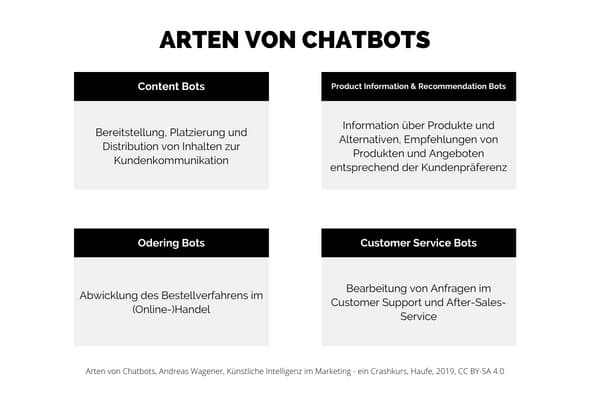
Chatbots can also be differentiated according to their field of application:
• Content Bots
• Info-Bots
• Ordering Bots
• Bots for customer service
Chatbots with voice input
Voicebots, with which customers communicate via voice input, are an extension of intelligent chatbots. Voicebots have a built-in intermediate stage in which the spoken language is converted into writing for the bot. The answer is then also given as a voice output via a text-to-speech system.
Advantages and disadvantages of rule-based chatbots
In rule-based chatbots, predefined request and response options are set. As a rule, the most frequent customer queries are taken as a basis. Rule-based chatbots therefore provide standardised answers to simple questions. However, in order to cover all conceivable chat processes with predefined answers, these bots are very complex to develop.
Advantages and disadvantages of AI-based chatbots
Intelligent chatbots are now one of the most important building blocks of digital customer service. They are gradually replacing rule-based systems. This is because they have the advantage that they can recognise and understand entered text, even with complex formulations. For the user, such a chatbot offers a significantly better user experience and appears much more immersive.
In the long run, an intelligent, AI-based system is also worthwhile from a cost perspective. While rule-based chatbots have to be set up and revised again and again, intelligent systems can be expanded gradually. They also have the advantage of being able to provide individual data on demand in real time. Our experience shows that companies using AI automation for their chat systems typically reduce first-response times by 60 to 80 percent.
How does the use of chatbots work in digital marketing?
In most shops, chatbots are set up by the web developer to function as 1:1 dialogue partners. In other words, there is one chat per enquiry or customer. The chatbot responds to the customer’s input within seconds. How targeted the answers and assistance of a chatbot are depends decisively on its connection to the shop’s customer and order management.
For whom is the use of chatbots worthwhile?
Using chatbots as part of the digital marketing mix is worthwhile for all companies that have many customer enquiries. In general, as the number of customers increases, one-to-one support becomes more difficult. Most webshops therefore use chatbots. In addition, customers today expect to find a contact person even outside working hours. Thanks to chatbots, this is now no longer a problem even for small businesses. What we see in practice across Swiss SMEs in the greater Zurich area: even companies with small teams are running chatbots that handle the majority of inbound enquiries without any human involvement. ONELINE will be happy to advise you on the use of suitable chatbots for your shop or website.
What do customers use chatbots for?
In order to optimally position one’s own shop in web development, the way in which customers use chatbots is decisive. Surveys on this show: the AI-controlled helpers in digital marketing are mainly used as a first point of contact and for simple enquiries.
In essence, chatbots have particular strengths in the following areas:
• Initial contact, with referral to service staff
• Answering simple enquiries about orders (e.g. delivery date)
• Mediation of product information
Acceptance of chatbots
The acceptance of chatbots as a tool in digital marketing is continuously increasing. It’s true that all of us have been frustrated at some point because a bot misunderstood our input. But with the increasing professionalisation of bots and ever better AI systems, the picture is changing. By 2026, the majority of customers actively prefer chatbots for simple requests because they get answers faster than waiting for a human agent.
Chatbots appreciated as helpful tools
Today, high-quality chatbots with an AI system can hardly be distinguished from a real, human contact partner by a layman. Customers appreciate chatbots mainly because they get quick answers and round-the-clock customer support.
What are the limits of chatbots in customer service?
Surveys and customer experience show that professionally set up chatbots with modern AI systems can handle many customer enquiries satisfactorily. However, the digital customer service agents reach their limits in one area: the handling of complaints.
While many bots are successfully used to accept complaints, resolving them emotionally is a real hurdle. Complaints can arise, for example, because of slight damage to the product or unsatisfactory processes when ordering. In addition to facts, the customer’s expectations and personal wishes also play a role.
However, these factors are extremely individual and personal. While one customer has no problem with partial deliveries, for another this upsets his entire planning. Creating automated responses to such individual sentiments is very difficult. Therefore, even in times of intelligent chatbots, complaint management is usually still the task of human customer service representatives.
Should chatbots be recognisable?
A chatbot should always be recognisable as a digital application. In other words, a shop operator should not make customers believe that they are chatting with a human advisor. Otherwise, the customer’s trust in the company may decline. In Switzerland, transparency around automated communication is increasingly expected, and in some regulated industries it is becoming a legal requirement.
This article was written by the ONELINE team. We have been supporting Swiss companies in digital transformation for over 10 years, from SEO and SEA to AI automation and lead generation.
Frequently Asked Questions
What does a chatbot cost for a Swiss SME?
That varies a lot. A simple rule-based chatbot can be set up for a few hundred francs. An intelligent, AI-based system with deep integration into your shop or CRM typically starts at CHF 3,000 to 10,000 for setup, depending on complexity. Ongoing costs depend on usage and the AI model behind it.
Can a chatbot also support lead generation?
Absolutely. Many companies use chatbots specifically to qualify website visitors and capture contact details before handing them off to sales. Combined with a solid lead generation strategy, chatbots can significantly increase conversion rates from organic and paid traffic.
How long does it take to implement a chatbot?
A rule-based chatbot can go live within a few days. An AI-based system with custom training and database connections typically takes four to eight weeks, depending on how much content needs to be fed in and how many integrations are required.
Does a chatbot replace human customer service?
No, and it shouldn’t. Chatbots handle repetitive, straightforward queries efficiently. Complex problems, complaints, and emotional situations still need a human. The most effective setups use chatbots to filter and triage, so human agents can focus on cases where they actually add value.
{“@context”: “https://schema.org”, “@type”: “Article”, “headline”: “Chatbots: Virtual employees are becoming increasingly important”, “description”: “”, “author”: {“@type”: “Organization”, “name”: “ONELINE”, “url”: “https://oneline.ch”}, “publisher”: {“@type”: “Organization”, “name”: “ONELINE”, “logo”: {“@type”: “ImageObject”, “url”: “https://oneline.ch/logo.png”}}, “datePublished”: “2022-08-04”, “dateModified”: “2026-07-12”, “mainEntityOfPage”: {“@type”: “WebPage”, “@id”: “https://oneline.ch/en/blog/2491/”}}