In Brief
Vibe coding works through a cycle of prompt, code, and correction: a task is described in plain language, an AI generates the code, the result is run, and adjusted again through a new prompt if needed. This process is often enough for quick prototypes; for growing or multi-person projects, a more controlled form of AI-assisted development comes into play.
To answer the question “How does vibe coding work?”, we first need to place the principle of this strongly AI-assisted approach to software development in context. Here, system requirements aren’t formulated directly in code, but in natural language, which an artificial intelligence then translates into program code. The typical process is simple: a task is described, the AI generates code, the result is run, and it’s then improved through new prompts. This cycle of prompt, code, and correction repeats until the desired function is achieved.
In the narrow sense, the focus isn’t on reading the code in detail. What matters first is whether the application does what’s expected. For simple experiments and quick prototypes, this approach can bring a lot of speed. In larger projects, however, a more controlled form of AI-assisted development often comes into play.
How Does Vibe Coding Work in Practice?
A First Prompt as an Example
At the start, there’s no programming language, only the desired result. Instead of creating functions, variables, or data structures yourself, you describe the task in a prompt.
A simple example would be:
«Write a Python function that reads a CSV file and prints all the records it contains.»
Anyone who lets AI generate code this way gets a first draft directly from the language model (large language model, LLM). The LLM generates code based on the described task and the patterns it knows from its training. The resulting program code is then run.
If everything works as expected, the next step follows. If an error occurs or a function is missing, the result is described again.
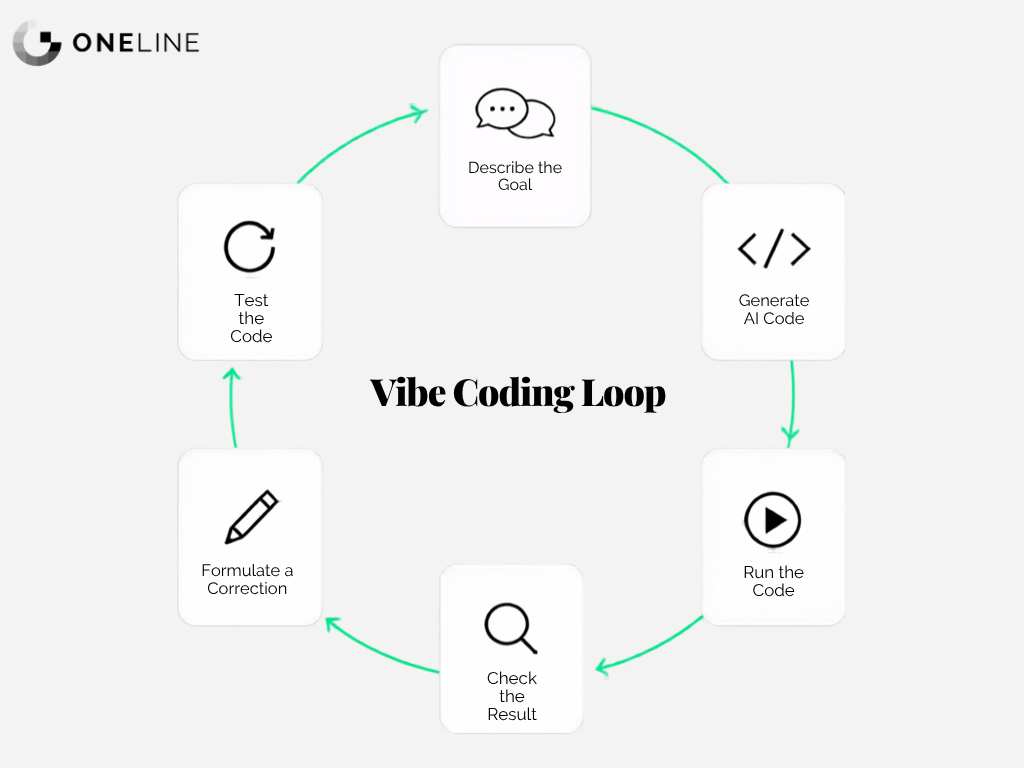
The Vibe Coding Loop in 6 Steps
The typical vibe coding loop consists of the following steps:
- Describe the goal or desired function
- Have the AI generate code
- Run the generated code
- Observe the result and error messages
- Formulate corrections or new requirements
- Test the revised code again
So what does vibe coding really come down to? The path to the result runs through an ongoing dialogue with the AI. Writing individual lines of code by hand fades into the background.
The name for this approach was coined in February 2025 by AI researcher Andrej Karpathy. We’ve summarized the origin, definition, and limits of the term in a separate article.
How Does a Prompt Become a Working Application?
How does AI actually write code in practice? As an example, let’s look at building a small task planner. The first prompt might simply ask for a web application in which tasks can be entered and displayed.
The AI generates the necessary LLM code. Once it’s running, it may turn out that tasks can be added but not deleted. Instead of searching through the program code, a new instruction follows:
«Add a button to each task so it can be deleted.»
The next adjustment works. Now it becomes clear that all entries disappear once the application is closed. The next prompt could be:
«Save the tasks so they’re still there after a restart.»
This is how the application grows step by step. New requirements emerge directly from the visible result. If an error message appears, it can simply be handed back to the AI. The model then tries to identify the cause and generate improved LLM code.
How Do You Write Good Prompts for AI-Generated Code?
Anyone who wants to generate code with AI should describe the desired result as clearly as possible. A vague prompt leaves the model a lot of room for interpretation. For early experiments, that may be enough. Once specific functions are required, an efficient development process calls for more precise input.
«Create a to-do list» describes only the basic idea.
Much clearer would be:
«Create a simple to-do list as a web application. New tasks should be addable, markable as done, and deletable. Entries should still be there after a restart.»
How does AI actually write code based on input like that? The model tries to translate the described functions into a technically feasible structure. The clearer the goal and behavior are formulated, the smaller the room for wrong assumptions. Anyone who builds prompts systematically also reduces the number of correction rounds.
Corrections also benefit from precise input. Instead of «that doesn’t work», a precise description of the problem gets you to the goal far more reliably.
What’s the Difference Between Pure Vibe Coding and AI-Assisted Development?
In the original, narrow sense of vibe coding, the generated program code stays largely in the background. Control focuses on the visible result. If something doesn’t work, the feedback goes back to the AI, which creates the next version. The approach delivers usable results quickly, but it isn’t always the right choice.
AI-assisted development goes a step further. Here, too, artificial intelligence is used to generate AI code and quickly produce a working application. Specialists, however, additionally check how the solution is built technically.
The difference can be summarized like this:
- Pure vibe coding checks mainly the result.
- AI-assisted development checks both the result and the code.
- Classic software engineering with AI additionally embeds the model in defined testing and quality processes.
This distinction is actually more relevant in practice than a strict either-or. A project can start freely and later move into a more controlled development process.
Unreviewed code carries real risks. Security vulnerabilities, as described in the OWASP Top Ten, occur in AI-generated code just as much as in code written by hand. Anyone who fixes errors systematically, instead of just working around them, noticeably lowers this risk.
What Does Controlled AI Development with Vibe Coding Look Like?
Here too, the process starts with a clear description of the task. The AI creates a first version of the LLM code. But after that, human control doesn’t stop at the visible result.
First, it’s checked whether the structure and logic fit the existing application. Functional tests follow next. Errors aren’t just fed back to the AI, they’re also assessed for their underlying cause.
A typical process looks like this:
- Define requirements
- Have the AI generate code
- Check structure and logic
- Test the function
- Fix errors specifically, either via the AI or by hand
- Re-check the changes
- Document and adopt the working code
So what does vibe coding look like in a professional setting? In its pure form, it often takes a back seat there to more controlled AI assistance. The speed advantage remains, but technical responsibility stays with the human.
When Is Pure Vibe Coding Enough, and When Do You Need More?
When Speed Matters More Than a Perfect Codebase
Not every project needs an elaborate development process from day one. For an early prototype, speed can matter more than a codebase that’s perfect in the long run.
If the goal, for example, is simply to check whether a user idea is understandable, a working draft can be enough. Small personal helper tools or one-off automations are also well suited to an approach closer to pure vibe coding.
When Applications Grow or Several People Build Together
It looks different for applications that run permanently, keep growing, or are maintained by several people over time. That’s where controlled AI-assisted development becomes far more important.
A study by ETH Zurich from 2026 shows just how much the prior knowledge of the person prompting matters. In a test with 100 students, computer science knowledge had the biggest impact on success in AI-assisted programming. People who used the AI especially often actually performed worse.
«Finished code» in pure vibe coding therefore initially just means: the observed result fulfills the task at hand. Whether the LLM code stays maintainable, secure, and extensible in the long run has to be assessed separately. Which model generates the code also makes a difference, especially for more complex tasks.
The Smooth Transition to Classic Software Engineering
So the question also has to be: when does vibe coding work best? Often, a smooth transition is the answer. The first idea comes from a quick prompt. The AI delivers a prototype that can be tested early. If the concept holds up, the technical rework begins.
Vibe coding mainly speeds up the path from an idea to a visible result. Classic development work then makes sure a robust application comes out of it. Anyone who knows the basics of a language like HTML recognizes more quickly whether generated code is built sensibly.
Would you like to work out how vibe coding, or a controlled, AI-assisted development approach, fits into your digital projects? Get in touch. We’ll assess your requirements, the right areas of application, and the development process that fits your context.

Written By
Bettina Abelman
Junior Online Marketing Manager at ONELINE in Zug, focused on digital marketing, SEO, and lead generation. Learn more about Bettina →