Understanding CPA and CPC is not optional in digital advertising, it’s the foundation of every campaign decision you make. Cost per click and cost per acquisition tell you completely different things about your campaign performance, and confusing the two leads to exactly the kind of budget waste we see regularly with Swiss SMEs, especially in competitive markets like Zurich and Zug. Whether you’re running Google Ads for the first time or optimising an existing account, these two metrics deserve your full attention.
What is the difference between CPA and CPC?
The CPC of a campaign tells you how expensive it is to get a click on an ad. A click means a user has landed on your website or landing page. Nothing more. It does not mean they bought anything, filled in a form, or did anything useful at all.
The CPA, on the other hand, shows exactly which costs are associated with a conversion, i.e. with a real result. The CPA is therefore the more meaningful metric for most businesses. It tells you precisely how much acquiring a new customer or qualified lead actually costs. In practice, this is the number that determines whether a campaign is profitable or not.
Calculate CPA
To calculate the CPA, divide the total campaign costs by the number of conversions. A conversion happens when a user does exactly what the ad was designed to make them do. That could be a product purchase, a newsletter signup, a completed contact form, or a consultation booking.
CPA = Cost of the campaign : Conversions
Calculate CPC
The CPC is calculated by dividing total campaign spend by the number of clicks generated. High CPC means few clicks. The ad probably wasn’t compelling enough. Low CPC means many clicks, which suggests the creative and targeting were on point.
But a low CPC alone tells you nothing about profitability. That’s where CPA comes in.
CPC = Cost of the campaign : Clicks on the ad
CPA and CPC as Google Ads strategies
When setting up a Google Ads campaign, you can choose CPA or CPC as your primary bidding strategy. With target CPA, you tell Google’s algorithm what you’re willing to pay per conversion. With manual CPC, you control individual bids directly. Both approaches have their place. Our experience shows that target CPA works well once a campaign has enough conversion data, typically at least 30 to 50 conversions per month. Before that threshold, manual CPC often gives you more control and cleaner learnings. Swiss campaigns in sectors like finance, legal, or B2B services in Zurich often need several weeks of data collection before smart bidding becomes reliable.
What is more important, CPA or CPC?
Both matter. But they answer different questions.
CPC tells you whether the ad itself is attractive enough to generate interest. CPA tells you whether the whole funnel is working, from the ad click through to the actual result on your landing page or shop. If CPC is healthy but CPA is too high, the ad is fine but the landing page isn’t converting. If CPA is solid but CPC is very high, you’re paying too much for each click and your creative or targeting likely needs refinement. For lead generation campaigns, CPA is almost always the North Star metric.
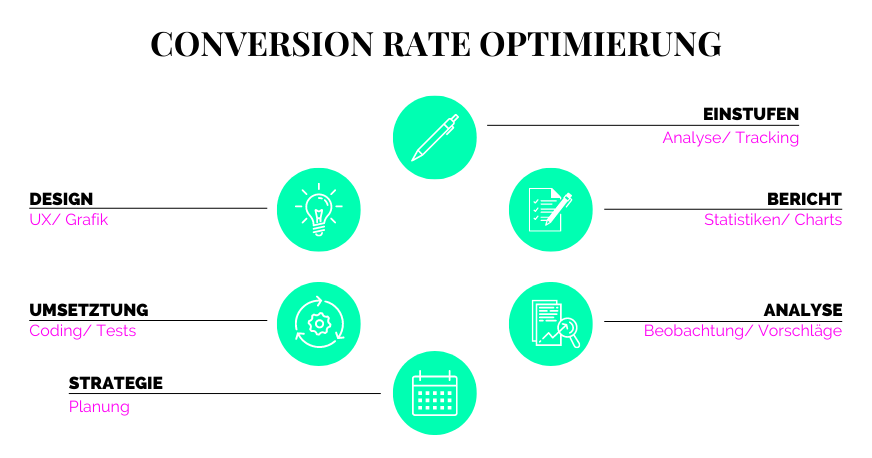
The most important success factor in online marketing: the conversion rate
The conversion rate (CR) is what connects CPC and CPA. It shows how many visitors to a website actually converted into customers or leads. Unlike CPA, which measures costs per success within a specific campaign, the CR reflects overall website performance across all traffic sources, paid and organic alike.
These types of conversion or acquisition are common:
• Sale
• Newsletter registration
• Booking a consultation or coaching session
• Request for quotation
• Participation in a survey
• Document download
• Contact form submission
What is a good conversion rate?
There’s no universal answer, but benchmarks help. For a web shop, a conversion rate around 2% is considered average. Anything consistently above 3 to 4% is strong. For newsletter signups, aim for 5 to 10%. B2B lead generation forms in the Swiss market often convert between 1 and 3%, depending on the offer and the qualification level expected from the visitor.
What we see in practice: many Swiss companies invest heavily in driving traffic but underinvest in the landing page experience. That’s a direct CPA problem. Better copy, clearer calls to action, trust signals like client logos or certifications, these can move conversion rates significantly without touching your ad budget. Our web development team handles exactly these kinds of conversion-focused improvements.
Conclusion: Know and evaluate CPA and CPC
CPA and CPC are complementary metrics. One without the other gives you an incomplete picture. Set rough targets for both before launching any campaign, then use them together to diagnose what’s working and what isn’t. Is the problem the ad? The landing page? The offer itself? These two numbers help you answer that quickly.
At ONELINE, we work with Swiss companies across Zurich, Zug, and beyond to build campaigns where both metrics move in the right direction. If you want a second opinion on your current Google Ads setup, we’re happy to take a look.
This article was written by the ONELINE team. We have been supporting Swiss companies in digital transformation for over 10 years, from SEO and SEA to AI automation and lead generation.
Frequently Asked Questions
What is a realistic CPA target for a Swiss B2B company?
That depends heavily on your average deal size and sales cycle. A Zurich-based software company selling a CHF 20,000 annual contract can justify a CPA of CHF 500 or more. A local service provider with CHF 200 average order value needs to keep CPA under CHF 30 to 40. Always work backwards from your margins, not from industry benchmarks.
Can I optimise CPC and CPA at the same time?
In principle, yes. But they sometimes pull in opposite directions. Broadening your targeting might lower CPC by increasing clicks, but those cheaper clicks may convert poorly, raising your CPA. The real goal is a low CPA, and CPC is one lever among several to get there.
How long does it take before a Google Ads campaign reaches a reliable CPA?
Typically four to eight weeks, assuming sufficient budget and traffic volume. Google’s smart bidding algorithms need at least 30 to 50 conversions per month to optimise effectively. Before that point, treat CPA data as directional rather than definitive.
Is CPA relevant for SEO campaigns too?
Indirectly, yes. SEO doesn’t have a direct cost per click, but you can calculate a cost per organic conversion by dividing your total SEO investment by the number of leads or sales generated from organic traffic. This makes it comparable to paid channels and helps you allocate budget more rationally.
{“@context”: “https://schema.org”, “@type”: “Article”, “headline”: “What do CPA and CPC mean?”, “description”: “CPA and CPC explained: learn what these key metrics mean for your Google Ads campaigns and how to use them effectively. By ONELINE Zurich.”, “author”: {“@type”: “Organization”, “name”: “ONELINE”, “url”: “https://oneline.ch”}, “publisher”: {“@type”: “Organization”, “name”: “ONELINE”, “logo”: {“@type”: “ImageObject”, “url”: “https://oneline.ch/logo.png”}}, “datePublished”: “2022-08-25”, “dateModified”: “2026-07-17”, “mainEntityOfPage”: {“@type”: “WebPage”, “@id”: “https://oneline.ch/en/blog/2482/”}}